
Women's Biology
February 20, 2026
The skin you have at 35 is not a slightly older version of the skin you had at 25, and the biology underneath is more specific than most women have been told.
A guide to the biology of skin aging — the cellular shifts, the hormonal turning points, and where the research on peptides actually fits in.
There’s usually a moment, somewhere between 33 and 38, when something changes.
Your skin used to bounce back. The crease from sleeping on one side faded by the time you’d had coffee. A late night might leave you tired, but it didn’t show on your face the way it does now. The moisturizer you’ve used for a decade still feels nice, but it stopped doing whatever it used to do. Friends who never wore makeup are suddenly asking about retinol. The conversation has shifted, and the products you trusted in your twenties don’t quite hold up the way they used to.
This isn’t your imagination. It’s biology, and it’s specific.
The skin you have at 35 is not a slightly older version of the skin you had at 25. It’s a structurally different tissue, governed by different rates of cellular turnover, supported by a different volume of structural protein, and increasingly responsive to hormonal shifts that haven’t started for most women yet but will. Understanding what’s actually happening underneath, what the research says is changing, when, and why, is the first step in deciding what to do about it.
This piece walks through the biology in plain language, anchored in real studies, and ends where most modern skin research is now pointing: at the peptide literature, where the most interesting work on skin remodeling has been happening for decades.
The 1% problem
Starting somewhere in the mid-twenties, the human body produces about 1% less collagen per year.[^1]
That number doesn’t sound like much. It isn’t, in any single year. But the math compounds, and the cumulative effect is dramatic. By 35, a woman has roughly 10% less collagen in her skin than she did at 25. By 45, that figure is closer to 20%. The structural protein that gives skin its firmness, its elasticity, its capacity to bounce back — there’s just less of it, year after year, in a way that follows the calendar more reliably than almost any other biological marker.
A 2007 study in The American Journal of Pathology helped explain why.[^2] Researchers at the University of Michigan compared skin fibroblasts, the cells responsible for producing collagen, from young adults (ages 18–29) to fibroblasts from older adults (ages 80+). They found that older cells produced collagen dramatically less, even when given the same biochemical signals. The age-related decline isn’t just a slowing of the system; it’s a change in the cells themselves.
What that means in practice: the same fibroblast that produced collagen efficiently at 25 produces it less efficiently at 35, and even less efficiently at 45. The decline isn’t dramatic enough to cause symptoms in any single year, which is exactly why it’s so disorienting when the cumulative effect finally becomes visible.
What you start to notice
The symptoms women describe in their thirties have a fairly consistent biological explanation.
Skin doesn’t bounce back the way it did. The first sign for most women is that creases from sleeping on one side, smile lines from a long day, or the impression of a phone pressed against the cheek take longer to disappear. This is elasticity, and it’s governed by elastin fibers and the dermal architecture that supports them. Both are produced by fibroblasts, and both decline with collagen.
Pigment becomes uneven. Sun damage that accumulated quietly throughout the twenties starts to surface as melasma, age spots, and uneven tone. A 2013 review in the International Journal of Cosmetic Science documented that melanocyte distribution and activity become increasingly irregular through the thirties, contributing to the patchy appearance that wasn’t there before.[^3]
Texture changes. Pores look different. Skin feels rougher to the touch. Fine lines appear in places that didn’t have them last year. This is a combination of slower cell turnover (which lengthens from roughly 28 days in your twenties to closer to 35-40 days in your thirties) and accumulated UV damage, which fragments the collagen and elastin fibers that give skin its smoothness.
Skin gets drier. The skin’s natural moisturizing factors, the lipids and humectants that keep the barrier intact, are produced less efficiently. Hyaluronic acid content in the dermis declines alongside collagen. Skin that didn’t need much beyond a basic moisturizer in your twenties suddenly seems to drink up everything you put on it.
Recovery time slows. A breakout in your twenties might have cleared in three days. The same breakout at 35 might leave a mark for three weeks. The wound healing capacity of skin, its ability to repair itself, declines with the same fibroblast aging that affects collagen production.
None of this is dramatic in any single moment. All of it is real, measurable, and largely predictable.
The accelerator no one warns you about
If the 1%-per-year decline is the gradual story, perimenopause is the accelerated one, and most women have no idea it’s coming.
Perimenopause is the transitional phase before menopause, often beginning in the late thirties or early forties, sometimes earlier. During this phase, estrogen levels fluctuate erratically before eventually declining. And estrogen, it turns out, has been quietly running much of the skin’s structural maintenance program your whole adult life.
The foundational research here comes from a 1987 study by Brincat and colleagues, published in the British Journal of Obstetrics and Gynaecology.[^4] They measured dermal collagen content in women across menopausal status and made a finding that has shaped skin aging research ever since: women lose approximately 30% of their dermal collagen in the first five years after menopause — followed by a steady 2.1% per year for the next fifteen years.
Read that again. Thirty percent in five years. After decades of losing 1% annually, the rate roughly sextuples.
The mechanism is hormonal. Estrogen receptors are densely concentrated in dermal tissue, and estrogen actively stimulates fibroblast collagen production while inhibiting the matrix metalloproteinases that break collagen down. When estrogen drops, both sides of the equation shift unfavorably at once: less production, more breakdown. A 2025 review in Journal of Cosmetic Dermatology documented that this acceleration follows menopausal age rather than chronological age, meaning a woman who enters perimenopause at 40 may have noticeably less dermal collagen at 50 than a woman of the same age who enters it at 52.[^5]
The reason this matters in your thirties is timing. The collagen you build and protect before perimenopause is the collagen you have during perimenopause. The interventions that work proactively, building dermal density, supporting fibroblast activity, protecting against accumulated damage, are far more effective than interventions trying to reverse the postmenopausal cliff after it’s already happened.
This is the science underneath the conventional wisdom that the thirties are the right time to get serious about skin. It isn’t vanity. It’s biology.
What the research actually points to
So what works? The honest answer is: less than the marketing claims, and more than skeptics admit.
The interventions with strong evidence are familiar. Daily broad-spectrum sunscreen prevents the photodamage that accelerates collagen breakdown. Topical retinoids, tretinoin, retinol, retinaldehyde have decades of clinical research showing they stimulate collagen synthesis and improve skin texture. Vitamin C, applied topically, supports collagen production through its role as a cofactor in the enzymatic reactions that build it. These three categories form the backbone of any evidence-based skin protocol, and they should.
But the research has been quietly moving in another direction for years now: peptides.
Peptides, short chains of amino acids, have become one of the most active areas of skin research because they work differently from the established interventions. Retinoids stimulate collagen indirectly by accelerating cell turnover. Vitamin C supports collagen by serving as an enzyme cofactor. Peptides can signal directly to the fibroblasts that produce collagen, instructing them at the cellular level to ramp up production.
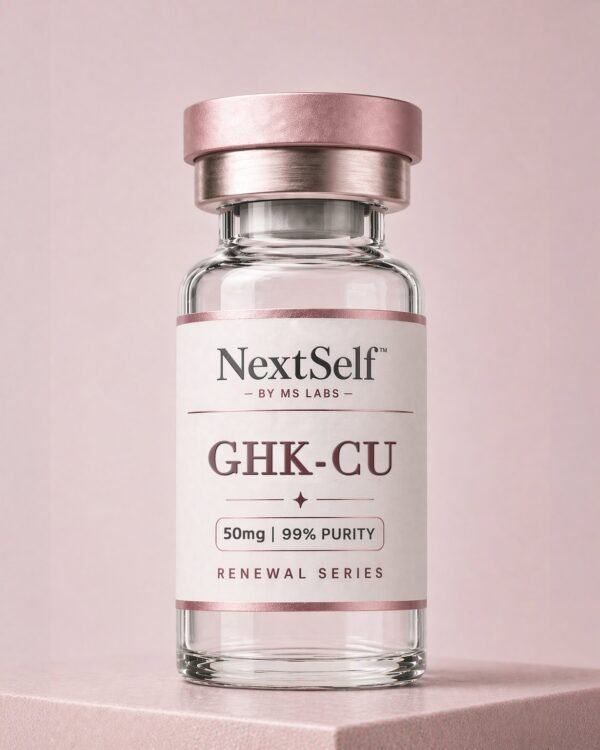
The most thoroughly studied peptide in this space is one that’s been in the literature for over fifty years: GHK-Cu.
GHK-Cu and what the studies actually showed
GHK-Cu, copper-bound glycyl-L-histidyl-L-lysine, was first isolated from human plasma in 1973 by researcher Loren Pickart.[^6] What he discovered, and what fifty years of subsequent research has confirmed, is that GHK-Cu is a naturally occurring tripeptide whose levels in the body decline measurably with age. Plasma levels at 20 average around 200 ng/mL. By 60, that figure drops to roughly 80 ng/mL — a decline that parallels the visible decline in skin repair capacity over the same decades.
The research on GHK-Cu’s effect on skin specifically is unusually well-documented in women.
In a 12-week study presented at the American Academy of Dermatology in 2002, dermatologist James Leyden and colleagues applied a GHK-Cu facial cream twice daily to 71 women with mild-to-advanced photoaging.[^7] At the end of the trial, the researchers documented increased skin density and thickness, reduced fine lines and wrinkle depth, improved skin laxity, and enhanced overall clarity.
A companion study presented the same week tested GHK-Cu eye cream on 41 women for 12 weeks, with results that outperformed both placebo and a vitamin K control.[^8]
The most striking finding came from a 1998 study by Abdulghani and colleagues, published in Disease Management & Clinical Outcomes.[^9] They measured the percentage of women who showed measurable increases in collagen production after topical application:
- GHK-Cu produced collagen increases in 70% of women.
- Vitamin C produced increases in 50%.
- Retinoic acid produced increases in 40%.
Three different interventions, head to head, in a study population of women — and the peptide outperformed two of the most-recommended topicals in dermatology.
A 2018 review in the International Journal of Molecular Sciences synthesized the broader research base.[^10] GHK-Cu has been documented to stimulate collagen and elastin synthesis in human dermal fibroblasts at concentrations as low as 0.01 nM. It modulates the expression of more than 4,000 human genes, including many of those involved in tissue remodeling. It supports the matrix-organizing molecule decorin, reduces inflammatory cytokines, and enhances wound healing capacity.
The mechanism is more comprehensive than retinoids or vitamin C, the direct evidence in women is stronger than for almost any topical anti-aging compound, and the research base is now five decades deep.
Where this leaves the woman in her thirties
The biology is clear, but the practical takeaway is more nuanced than a list of products.
The thirties are the decade when the rate of collagen decline starts to outpace the body’s natural repair capacity. They’re also the decade before the perimenopausal acceleration, which means the choices made during these years compound disproportionately. The interventions that address the actual biology — fibroblast activity, collagen synthesis, photoprotection, hydration support — are the ones worth investing in. The interventions that don’t address the biology are decoration.
Sunscreen remains the single highest-leverage daily intervention. Retinoids and vitamin C are well-supported. And peptide research, particularly GHK-Cu, has emerged as one of the more interesting categories in the modern skin literature, partly because the mechanism is direct, and partly because the women-centered evidence base is unusually robust.
Most peptide research has historically been conducted in male animal models or male-skewed human trials. This is not the case for GHK-Cu. The foundational human studies were specifically conducted on women, and the findings have held up to fifty years of subsequent research.
NextSelf Labs offers GHK–Cu as a research peptide for laboratory use — alongside other peptides whose roles in skin and recovery research are increasingly well-characterized. The catalog is built around the proposition that women considering peptides deserve to know what the research actually shows. For a deeper look at why we built the catalog this way, you can read our essay on the peptide research women were left out of.
The decade is when the math starts to compound. Knowing that, and choosing accordingly, is most of the work.
References
[^1]: Sibilla, S., Borumand, M., Sanchez Calabuig, J. M., Holbrook, K., et al. (2015). “Skin collagen through the lifestages: importance for skin health and beauty.” Plastic and Aesthetic Research, 2, 254–263. The widely-cited figure of ~1% annual collagen decline beginning in the mid-twenties is documented across multiple reviews; this paper provides the synthesis.
[^2]: Quan, T., Shao, Y., He, T., Voorhees, J. J., & Fisher, G. J. (2010). “Reduced expression of connective tissue growth factor (CTGF/CCN2) mediates collagen loss in chronologically aged human skin.” Journal of Investigative Dermatology, 130(2), 415–424. Earlier related work: Varani, J., Dame, M. K., Rittie, L., Fligiel, S. E., Kang, S., Fisher, G. J., & Voorhees, J. J. (2006). “Decreased Collagen Production in Chronologically Aged Skin: Roles of Age-Dependent Alteration in Fibroblast Function and Defective Mechanical Stimulation.” American Journal of Pathology, 168(6), 1861–1868. PMC1606623.
[^3]: Yaar, M., & Gilchrest, B. A. (2007). “Photoageing: mechanism, prevention and therapy.” British Journal of Dermatology, 157(5), 874–887. Documents melanocyte distribution changes and pigmentation irregularity associated with chronological and photoaging.
[^4]: Brincat, M., Versi, E., O’Dowd, T., Moniz, C. F., Magos, A., Kabalan, S., & Studd, J. W. (1987). “Decline in skin collagen content and metacarpal index after the menopause and its prevention with sex hormone replacement.” British Journal of Obstetrics and Gynaecology, 94(2), 126–129. The foundational study on postmenopausal collagen loss.
[^5]: Lephart, E. D., & Naftolin, F. (2022). “Menopause and the Skin: Old Favorites and New Innovations in Cosmeceuticals for Estrogen-Deficient Skin.” Dermatology and Therapy, 12(7), 1593–1611. Comprehensive review of estrogen’s role in skin biology and the postmenopausal acceleration.
[^6]: Pickart, L. (1973). The original isolation of GHK from human plasma albumin. Foundational reference cited in subsequent reviews including Pickart & Margolina (2018).
[^7]: Leyden, J., Stephens, T., Finkey, M., Appa, Y., & Barkovic, S. (2002). “Skin Care Benefits of Copper Peptide Containing Facial Cream.” Proceedings of the American Academy of Dermatology 60th Annual Meeting, New Orleans, LA, February 22–27, 2002.
[^8]: Leyden, J., Stephens, T., Finkey, M., & Barkovic, S. (2002). “Skin Care Benefits of Copper Peptide Containing Eye Creams.” Proceedings of the American Academy of Dermatology 60th Annual Meeting, New Orleans, LA, February 22–27, 2002.
[^9]: Abdulghani, A., Sherr, A., Shirin, S., Solodkina, G., Tapia, E., Wolf, B., & Gottlieb, A. B. (1998). “Effects of topical creams containing vitamin C, a copper-binding peptide cream and melatonin compared with tretinoin on the ultrastructure of normal skin — A pilot clinical, histologic, and ultrastructural study.” Disease Management & Clinical Outcomes, 1(4), 136–141.
[^10]: Pickart, L., & Margolina, A. (2018). “Regenerative and Protective Actions of the GHK-Cu Peptide in the Light of the New Gene Data.” International Journal of Molecular Sciences, 19(7), 1987. PMC6073405.
This piece reflects the views of NextSelf Labs and is intended for educational purposes. NextSelf Labs sells research peptides for laboratory use only. Products are not intended for human consumption, therapeutic use, or diagnostic application. Information presented here should not be construed as medical advice. Consult a qualified healthcare provider for any decisions regarding personal health, including hormonal therapies, prescription skincare, or interventions related to perimenopause and menopause.