
Research
January 4, 2026
For decades, peptide science treated women as an afterthought. GHK-Cu was the rare molecule that didn’t.
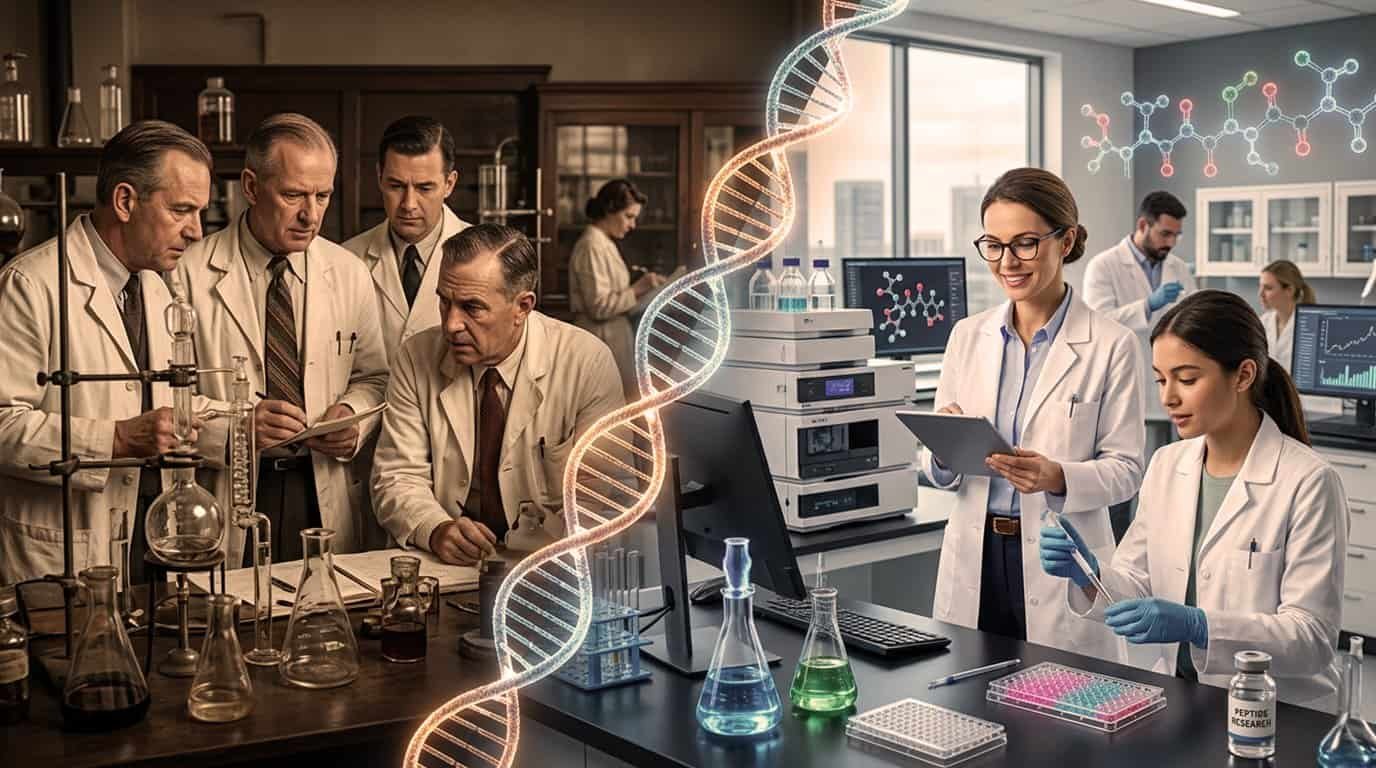
A founding essay on why most peptide science still skews male, and what that means for the women considering it.
For most of modern medicine’s history, the female body was an inconvenience. Hormonal cycles complicated the data. Pregnancy risk added liability. Researchers, almost without exception male, designed studies around male physiology and assumed the results would generalize.
In 1977, the U.S. Food and Drug Administration formalized this assumption into policy, recommending that “women of childbearing potential” be excluded from Phase I and early Phase II clinical trials.[^1] In practice, researchers interpreted the guidance broadly — excluding not only women who might become pregnant, but single women, women on contraception, even women whose partners had vasectomies.[^2]
The exclusion lasted nearly two decades.
It wasn’t until June 10, 1993, that Congress passed the NIH Revitalization Act, finally requiring federally funded clinical research to include women in numbers sufficient to detect whether a treatment affected them differently than men.[^3] That same year, the FDA reversed its 1977 guidance.[^4]
But by then, the damage was done. A 1992 Government Accountability Office report had already determined that 60% of FDA-approved drugs at that point had been tested without adequate representation of women.[^5] An entire generation of medical knowledge — what compounds did, at what doses, with what side effects — was built on the assumption that male physiology was the human default.
That assumption shaped everything that followed. Including, as it happens, peptide research.
What that meant for peptide science
Peptide research occupies an unusual corner of biomedical science. Most of the foundational work happens in animal models, typically male rodents, chosen because their hormonal stability produces cleaner data. By the time a peptide reaches human trials, it has often been characterized for years through male-skewed preclinical research. The early human studies, when they happen, frequently follow the same pattern: small, often male-dominated, often focused on conditions for which male physiology was assumed to be representative.
The result is a peptide literature where, even today, women appear primarily as a footnote. Sometimes they’re included in trials. Often they’re not. When they are, sample sizes are rarely large enough to draw conclusions specific to female physiology — the very situation the 1993 Revitalization Act was supposed to prevent.
This isn’t a conspiracy. It’s the slow inertia of a research culture that built its foundations before women were required to be in the room.
For women considering peptides today, this matters in concrete ways. The mechanism studies on most peptides? Often male animals. The pharmacokinetic profiles? Often male humans. The side effect data? Frequently extrapolated. When a peptide’s literature says “studies have shown” or “research suggests,” the relevant question is increasingly: studies of whom?
Most peptide science cannot answer that question cleanly. Some can.
GHK-Cu: the exception
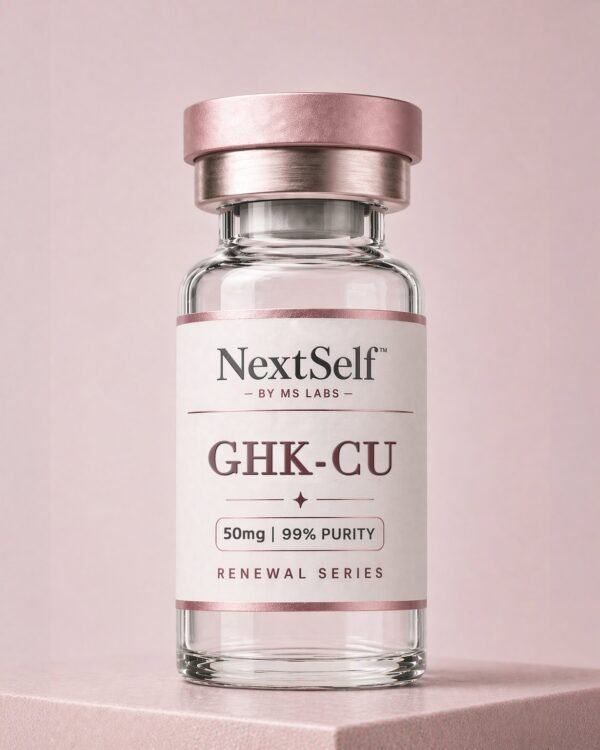
In 2002, dermatologist James Leyden and his colleagues presented two studies at the American Academy of Dermatology’s 60th Annual Meeting in New Orleans. Both used the same compound: a copper-bound tripeptide called glycyl-L-histidyl-L-lysine, better known as GHK-Cu.
The first study enrolled 71 women with mild-to-advanced photoaging.[^6] For 12 weeks, they applied a GHK-Cu facial cream twice daily. At the end of the trial, the researchers documented increased skin density and thickness, reduced fine lines and wrinkle depth, improved skin laxity, and enhanced clarity. Quietly, in the literature on photoaging, this became one of the most-cited studies of any topical anti-aging compound.
The second study, presented the same week, enrolled 41 women and tested a GHK-Cu eye cream for 12 weeks. The control wasn’t a placebo; it was a vitamin K cream, a then-popular treatment for periocular discoloration and fine lines. GHK-Cu outperformed both placebo and vitamin K for reducing periorbital lines and improving skin density.[^7]
A few years earlier, in 1998, Abdulghani and colleagues had published what may be the most striking finding in the entire GHK-Cu literature.[^8] In a head-to-head comparison of topical creams on women with photoaged skin, they measured the percentage of subjects who showed measurable increases in collagen production after treatment.
GHK-Cu produced collagen increases in 70% of treated women.
Vitamin C has long held up as the gold standard topical antioxidant, producing increases in 50%.
Retinoic acid, the molecule against which all other anti-aging compounds are typically measured, produced increases in 40%.
What unites these three studies isn’t just the consistent finding. It’s the population. In an era when women were being added to clinical research as an afterthought — when the literature was still catching up to fifteen years of exclusion. GHK-Cu’s foundational human evidence was being built specifically on female subjects.
This was not an accident. The cosmetics industry, more than the pharmaceutical industry, had always been forced to study women because women were the customers. But it was unusual for that work to produce peer-reviewed clinical evidence with the rigor of the Leyden trials. And it was unusual for the resulting data to be replicated, expanded, and integrated into a broader regenerative biology literature — which it was, in two major reviews co-authored by Loren Pickart, the researcher who first isolated GHK from human plasma in 1973.[^9][^10]
The result is that GHK-Cu sits in a small group of peptides where the question “but does it work in women?” has been asked, answered, and published. Not many peptides can claim that.
What the gap still looks like today
GHK-Cu is the exception, not the rule.
For most of the peptide catalog, BPC-157, the growth hormone secretagogues, the metabolic peptides, and the longevity compounds, the available human research is either limited, skewed male, or both. This isn’t a fatal flaw. Animal models tell us real things about how molecules work. Mechanism studies in male subjects can produce findings that genuinely do generalize. And in some cases, like the GLP-1 receptor agonists that have reshaped metabolic medicine in the last few years, large clinical trials have included women in significant numbers from the start.
But “limited research in women” isn’t the same as “no research.” It’s a flag worth waving.
For example: BPC-157, one of the most-studied recovery peptides, has been the subject of more than three decades of preclinical research. Almost all of it was conducted in animal models, the majority in male rats. Human pilot studies have begun, but the literature is thin and predominantly recent. A woman researching BPC-157 today is reading thirty years of male-rodent data extrapolated through a small handful of human pilot trials.
This is not a reason to dismiss BPC-157. It is a reason to be honest about what the research actually shows.
The same caveat applies, in varying degrees, to most of the peptide literature. Tirzepatide and semaglutide have substantial female trial data. Sermorelin has been studied in mixed-sex populations for decades. But most of the rest , Ipamorelin, CJC-1295, MOTS-C, SS-31, KPV, have research bases where women’s specific representation ranges from “included” to “rarely studied separately.”
There is one other exception worth naming.
The peptide developed for women
In June 2019, the FDA approved a peptide called bremelanotide, sold under the brand name Vyleesi, for the treatment of hypoactive sexual desire disorder in premenopausal women.[^11] The approval was based on two identical Phase 3 randomized, double-blind, placebo-controlled trials.[^12] Both trials enrolled exclusively premenopausal women with acquired, generalized HSDD of at least six months’ duration.
The peptide is more commonly known in research circles as PT-141.
What makes PT-141 unusual isn’t just the female-only trial population. It’s that the compound was developed for women. Earlier libido interventions, almost universally, were developed first for male physiology — primarily through vascular mechanisms — and then either tested on women as an afterthought or simply assumed to work the same way. PT-141 was developed from the beginning around the recognition that female sexual function is not primarily a vascular problem. It is a neurological one.
The peptide acts on melanocortin receptors in the central nervous system — the brain regions involved in the response to sexual cues and emotional arousal. The mechanism is fundamentally different from anything that came before it, and the research foundation reflects that difference: the trials were designed by, for, and on women.
GHK-Cu and PT-141 do not constitute a complete answer to a fifty-year research deficit. But they are evidence that better is possible. They are what peptide research looks like when women are the question, not the afterthought.
What we’re building
NextSelf Labs is a research-grade peptide catalog for a small but real proposition: that women considering peptides deserve to know what the research actually says.
Some of the peptides we offer have substantial female-centered evidence. GHK-Cu does. PT-141 does. Kisspeptin, the master regulator of the female reproductive axis, has been at the center of women’s hormonal research since its discovery in 1996.
Most of the rest don’t. The recovery peptides, the metabolic peptides, the longevity compounds, these have research bases that range from solid-but-male-skewed to genuinely thin. We carry them because researchers want them, and because the alternative is leaving women to sort through the inevitable confusion of an under-vetted market on their own. But we describe them honestly. The relevance to women’s research, where it exists, is framed through what’s actually been studied, not invented.
Our work, more than anything, is to be the catalog that gives women credit for asking good questions.
The questions worth asking are usually the ones the research has been quietly avoiding. Was this studied on women? In what numbers? At what doses? With what controls? In what populations? These are the questions a discerning researcher already knows to ask. They’re also the questions that, until 1993, the research establishment was free to ignore.
Thirty-three years later, the answers are getting better. Slowly.
References
[^1]: U.S. Food and Drug Administration. General Considerations for the Clinical Evaluation of Drugs. HEW (FDA) 77-3040, 1977. The 1977 FDA policy recommended excluding women of childbearing potential from Phase I and early Phase II drug trials.
[^2]: Embryo Project Encyclopedia. “Title 1, Subtitle B, Parts I, II, and III of the ‘National Institutes of Health Revitalization Act of 1993’.” Documents the broad interpretation of the 1977 FDA guidance to exclude all women.
[^3]: U.S. Congress. NIH Revitalization Act of 1993, Public Law 103-43, signed June 10, 1993. Section 492B mandates the inclusion of women and minorities in NIH-funded clinical research. NIH Office of Research on Women’s Health: History.
[^4]: U.S. Food and Drug Administration. Guideline for the Study and Evaluation of Gender Differences in the Clinical Evaluation of Drugs, 1993. Reversed the 1977 exclusion guidance.
[^5]: U.S. Government Accountability Office, GAO Report HRD-93-17, 1992. Found that 60% of FDA-approved drugs had been tested in trials with insufficient representation of women.
[^6]: Leyden, J., Stephens, T., Finkey, M., Appa, Y., & Barkovic, S. (2002). “Skin Care Benefits of Copper Peptide Containing Facial Cream.” Proceedings of the American Academy of Dermatology 60th Annual Meeting, New Orleans, LA, February 22–27, 2002.
[^7]: Leyden, J., Stephens, T., Finkey, M., & Barkovic, S. (2002). “Skin Care Benefits of Copper Peptide Containing Eye Creams.” Proceedings of the American Academy of Dermatology 60th Annual Meeting, New Orleans, LA, February 22–27, 2002.
[^8]: Abdulghani, A., Sherr, A., Shirin, S., Solodkina, G., Tapia, E., Wolf, B., & Gottlieb, A. B. (1998). “Effects of topical creams containing vitamin C, a copper-binding peptide cream and melatonin compared with tretinoin on the ultrastructure of normal skin — A pilot clinical, histologic, and ultrastructural study.” Disease Management & Clinical Outcomes, 1(4), 136–141.
[^9]: Pickart, L., Vasquez-Soltero, J. M., & Margolina, A. (2015). “GHK Peptide as a Natural Modulator of Multiple Cellular Pathways in Skin Regeneration.” BioMed Research International, 2015, 648108. PMC4508379.
[^10]: Pickart, L., & Margolina, A. (2018). “Regenerative and Protective Actions of the GHK-Cu Peptide in the Light of the New Gene Data.” International Journal of Molecular Sciences, 19(7), 1987. PMC6073405.
[^11]: U.S. Food and Drug Administration. FDA Approval of Vyleesi (bremelanotide injection), NDA 210557, June 21, 2019. FDA Approval Package.
[^12]: Clinical trial registrations: NCT02333071 and NCT02338960. Both Phase 3 randomized, double-blind, placebo-controlled trials of bremelanotide in premenopausal women with acquired, generalized HSDD. Simon, J. A., Kingsberg, S. A., et al. (2019). “Bremelanotide: First Approval.” Drugs, 79(13), 1473–1480. PubMed: 31429064.
This piece reflects the views of NextSelf Labs and is intended for educational purposes. NextSelf Labs sells research peptides for laboratory use only. Products are not intended for human consumption, therapeutic use, or diagnostic application. Information presented here should not be construed as medical advice. Consult a qualified healthcare provider for any decisions regarding personal health.